
One of the biggest mistakes in conversational AI is pretending automation can solve everything.
In healthcare, this becomes dangerous.
We designed the system to intentionally recognize moments where:
- Emotional reassurance was needed
- Clinical ambiguity existed
- Regulations required human involvement
- Patient safety took priority
The assistant could intelligently defer to:
- Pharmacists
- Customer support
- Live care teams
without breaking the experience.
This “human-in-the-loop” approach became a foundational design principle.
The goal was never to replace pharmacists.
It was to make expert healthcare support more accessible.
1. Healthcare Requires Emotional UX
People are not simply “users” in healthcare systems. They are patients dealing with uncertainty.
2. AI Should Reduce Anxiety, Not Add Complexity
The best conversational systems simplify difficult moments.
3. Human Escalation Is Part of Good AI Design
The smartest systems know when to step aside.
4. Context Is Everything
Healthcare conversations become exponentially more useful when tied to patient history and real-time prescription context.
We introduced patterns such as:
Progressive Disclosure
Only presenting information when needed to avoid overwhelming users.
Context Retention
Remembering prior interactions within a session:
“You asked about this prescription earlier.”
Confidence-Based Escalation
If the system detected ambiguity or elevated risk, it deferred gracefully:
“I’d like to connect you with a pharmacist to make sure you get the best guidance.”
Conversational Shortcuts
Returning users could perform complex actions with fewer steps:
“Refill my usual prescriptions.”
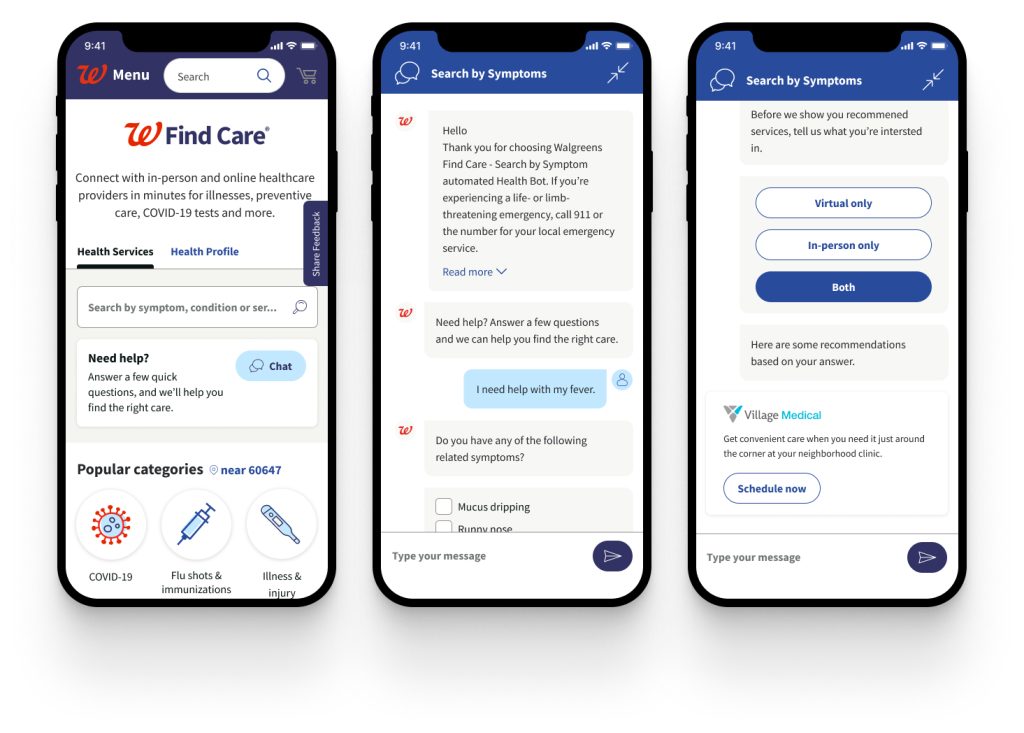
Designing conversational healthcare systems at Walgreens was an early exploration into what has now become a massive shift toward AI-assisted healthcare experiences.
But the core lesson remains timeless:
Great healthcare technology does not replace human care.
It creates better pathways to it.
The future of healthcare UX lies not in removing people from the experience—but in designing systems that make expertise, empathy, and support more immediate and accessible than ever before.
